
The Blueprint:
How SpaceX Plans to Colonize the Cosmos in the Next One Hundred Years
Next month’s SpaceX IPO is being called the biggest in history.
I think the analysts are missing the actual story.
Elon Musk isn't building a rocket company. He's building something much more interesting: a way to send human consciousness to the stars.
Think about it: SpaceX is just one of eight companies Musk runs. Why does a rocket company need a brain-implant company? Why does a car maker need an AI lab?
I went looking for answers. And I think I found them.
It's not what Musk says publicly. It's in what his companies, taken together, are able to do.
Here's the punchline, then I'll show you the work:
Humans cannot be moved at useful interplanetary speeds. Human consciousness can.
Every Musk company — SpaceX, Tesla, Neuralink, xAI, The Boring Company, Starlink, Optimus — is a necessary component of a single 100-year system whose purpose is to encode, transmit, and re-embody human minds at the speed of light.
Earth builds the prototype.
The Moon builds the factory.
Orbital data centers spread the word.
Mars proves the concept.
The stars are the destination.
I call it The Blueprint.
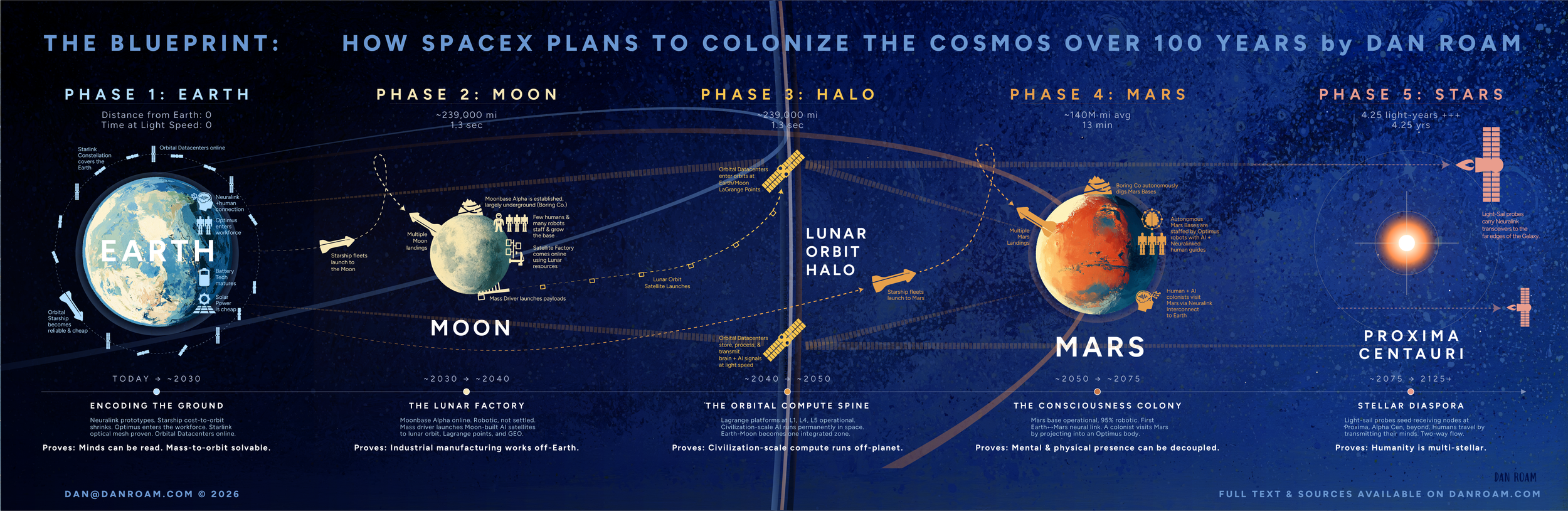
The images below walk through all five phases.
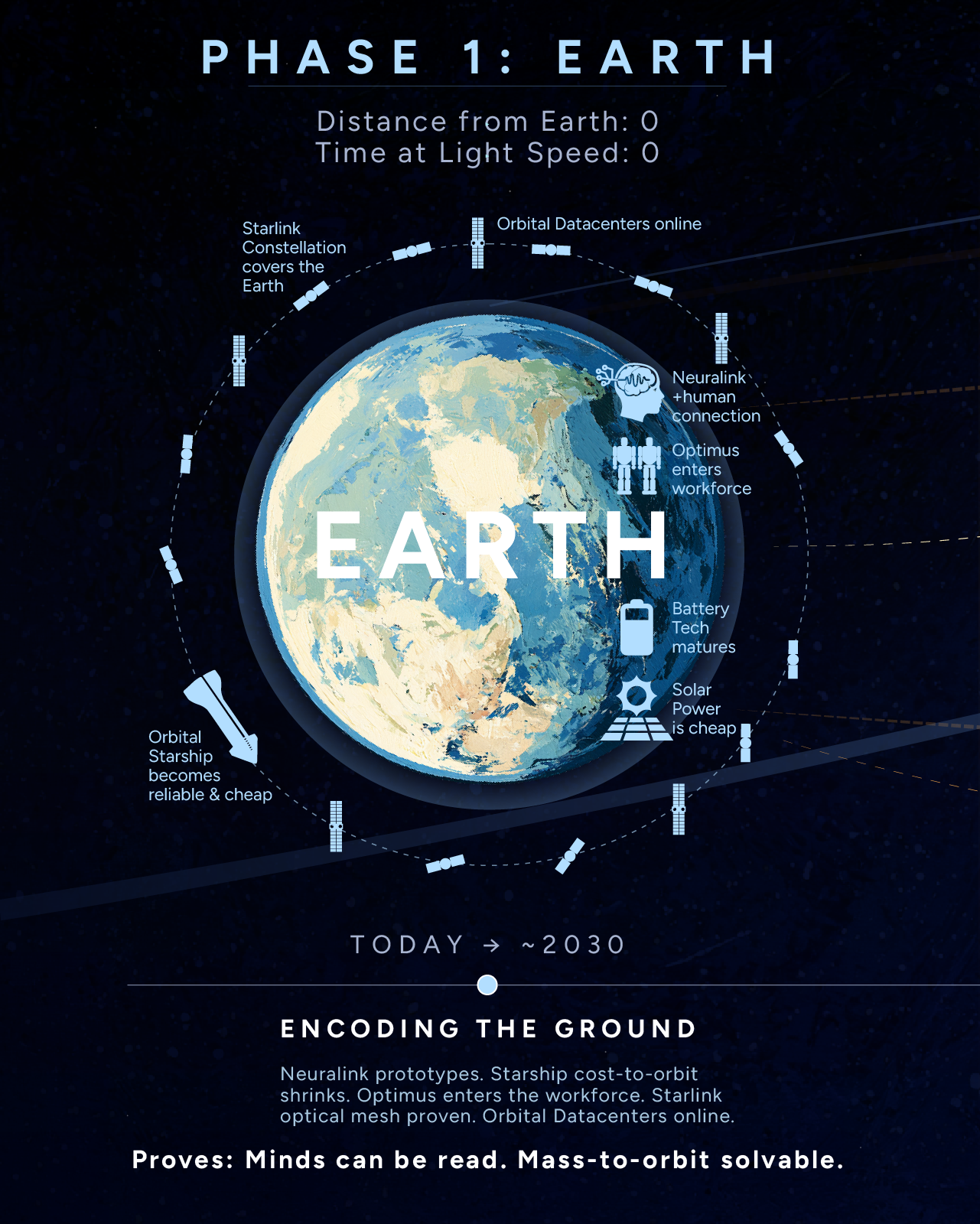
Phase 1 — EARTH (today → 2030). Neuralink learns to read human thought. Optimus learns skilled physical work. Starship makes mass-to-orbit cheap. xAI's compute substrate gets ready. Every component of the consciousness-transmission stack gets prototyped on Earth.
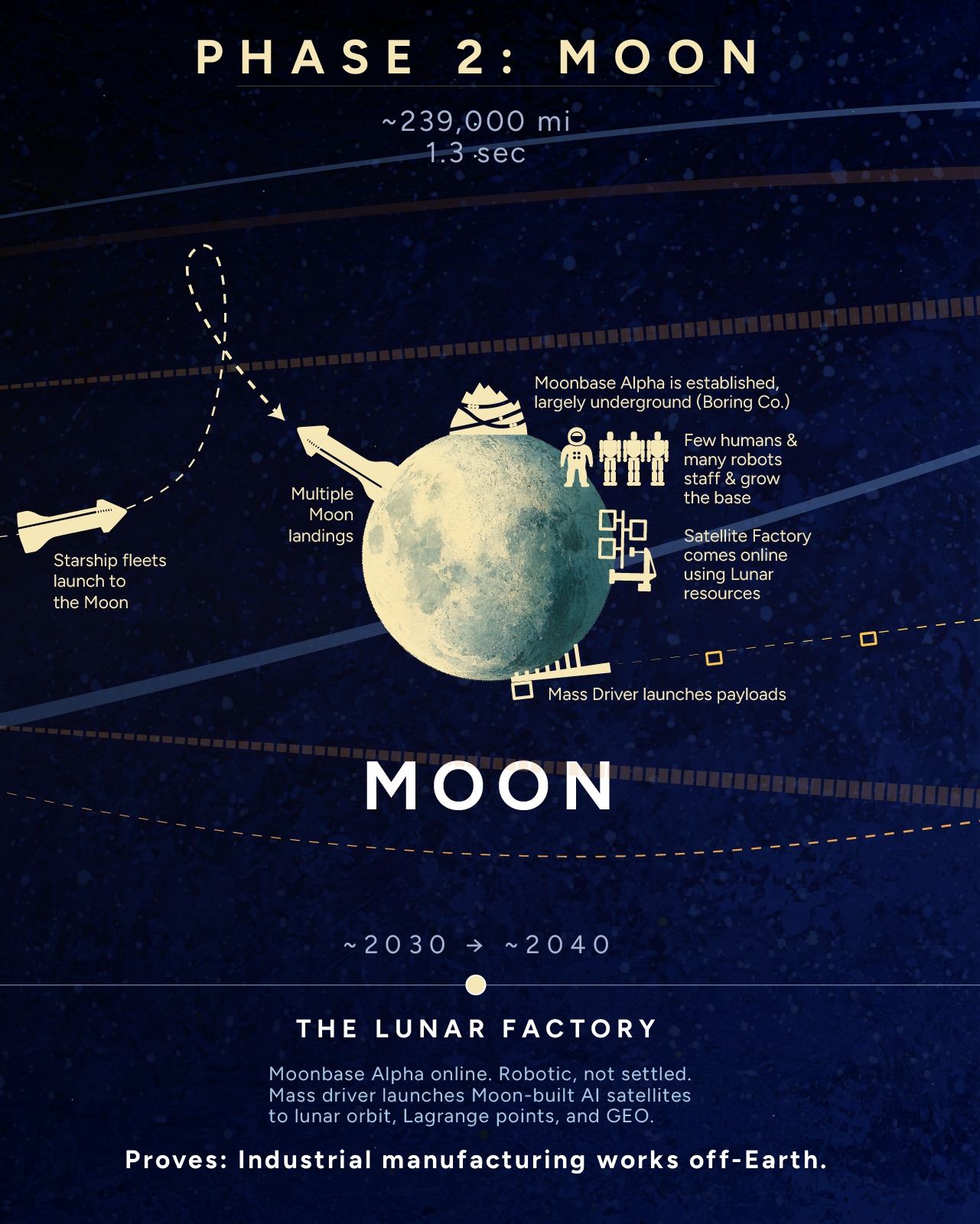
Phase 2 — MOON (2030 → 2050). Robotic industrial complex on the lunar surface, built by Optimus, powered by Tesla, tunneled by Boring Co. Almost no humans. A mass driver — a long electromagnetic launch track — fires Moon-built AI satellites into cislunar space at 2.38 km/sec, no chemical propellant required. The Moon becomes the factory.
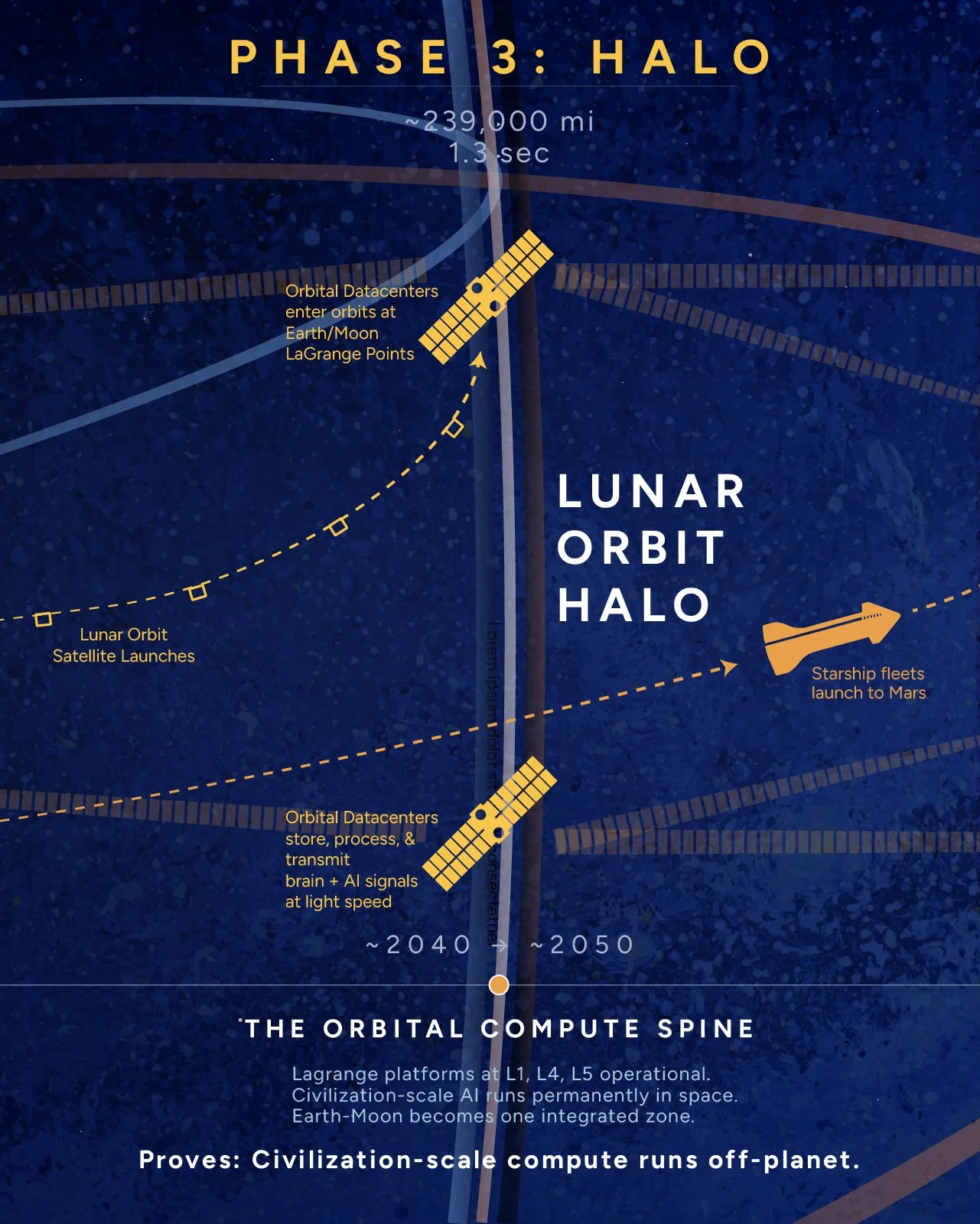
Phase 3 — HALO (2045 → 2065). LEO (precursor) and the Lagrange points between Earth and Moon (long-form) fill up with permanent solar-powered compute platforms. Continuously sunlit. Gravitationally stable. The substrate on which civilization-scale AI now runs. The Earth-Moon system becomes one integrated economic and computational zone.
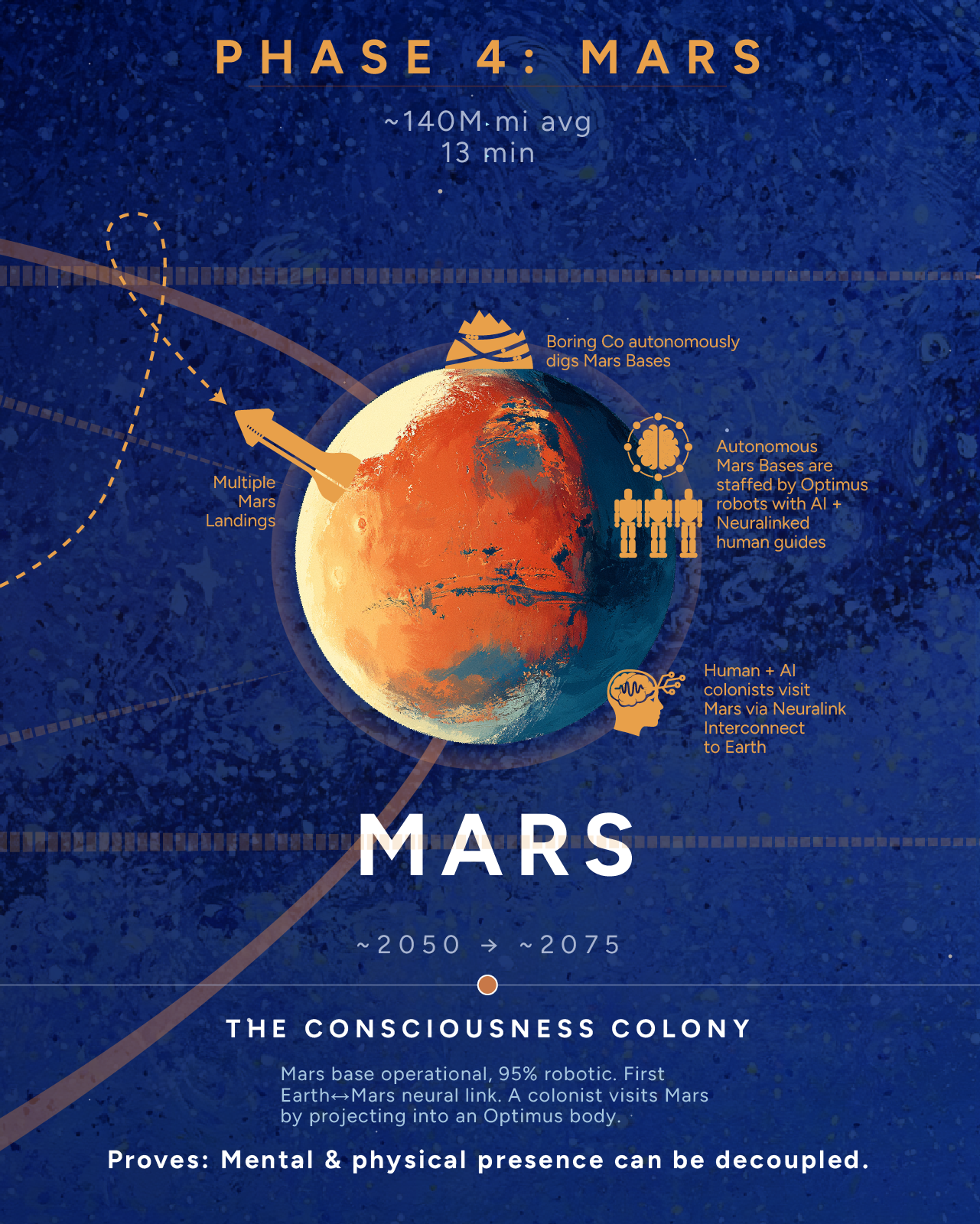
Phase 4 — MARS (2065 → 2090). A robotic Mars base goes operational before any human sets foot there. When humans do visit, they come in small numbers. The real population of Mars is consciousness, projected into Optimus bodies via Neuralink. A colonist on Earth puts on a headset and spends a shift on Mars. Light-lag is 8–48 minutes one way. Presence and biological location are now decoupled.
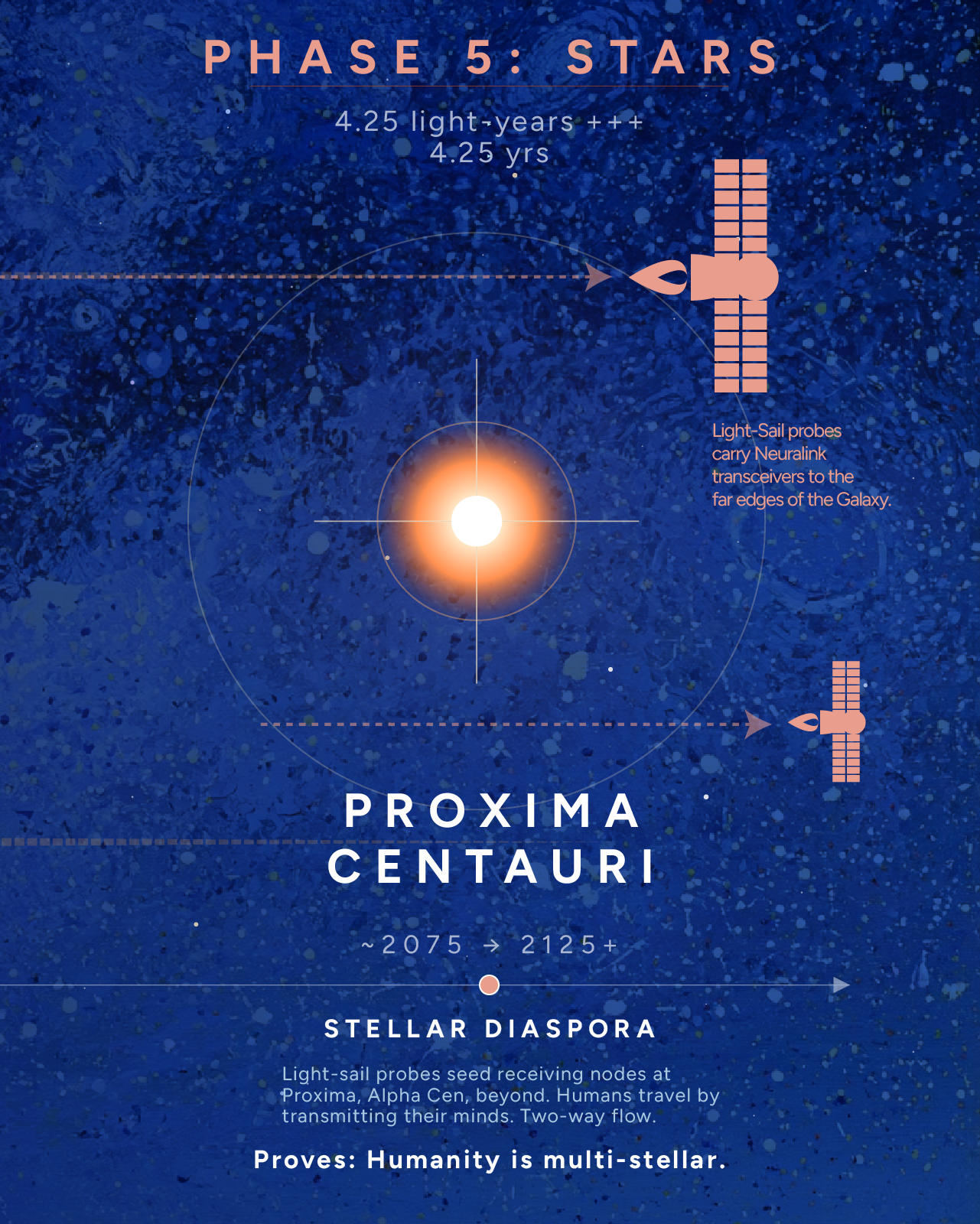
Phase 5 — STARS (2090 → 2125+). Light-sail probes seed receiving nodes at Proxima Centauri, Alpha Centauri, Wolf 359. Once a node is live, any consciousness can be transmitted there at light speed and instantiated in a waiting body. A "trip to Proxima" takes 4.2 years for the signal; instantaneous for the traveler. The architecture goes recursive. Each new stellar node seeds further stars.
This is what the SpaceX IPO is really funding.
Two things worth considering as you read this:
First, Musk has said the parts out loud. "My plan is to use the money to get humanity to Mars and preserve the light of consciousness" (X, Oct 2021). "You can take a rough snapshot of someone's mind with Neuralink and upload that rough copy into a robot body. I think at some point it will be possible, probably in less than 20 years" (Tesla shareholder meeting, 2024). The goal — light of consciousness — is his phrase. The mechanism — upload into a robot body — is his prediction. The architecture connecting them is what I've drawn.
Second, the financial press isn't asking these questions because the financial press isn't paid to. The "smart money" is pricing year-over-year cash flow. The smart bet — the one Musk's investors are actually making — is that the combined portfolio is worth more than the sum of its parts because the parts only make sense together.
You don't have to like Elon Musk to find this interesting. You just have to be willing to see the pattern.
Curious whether you see it.
Do you think this read of his portfolio is right, partly right, or completely wrong? What does the alternative interpretation look like? Reply in the comments — I'm genuinely interested in pushback.
— Dan Roam
Full research, sources, and notes may be found below.
a special thank you to mark rubin
Deepest thanks to my great friend, client, and colleague Mark Rubin. Mark provided the early inspiration for this story, and worked with me to develop the early whiteboards that eventually became what you see here.
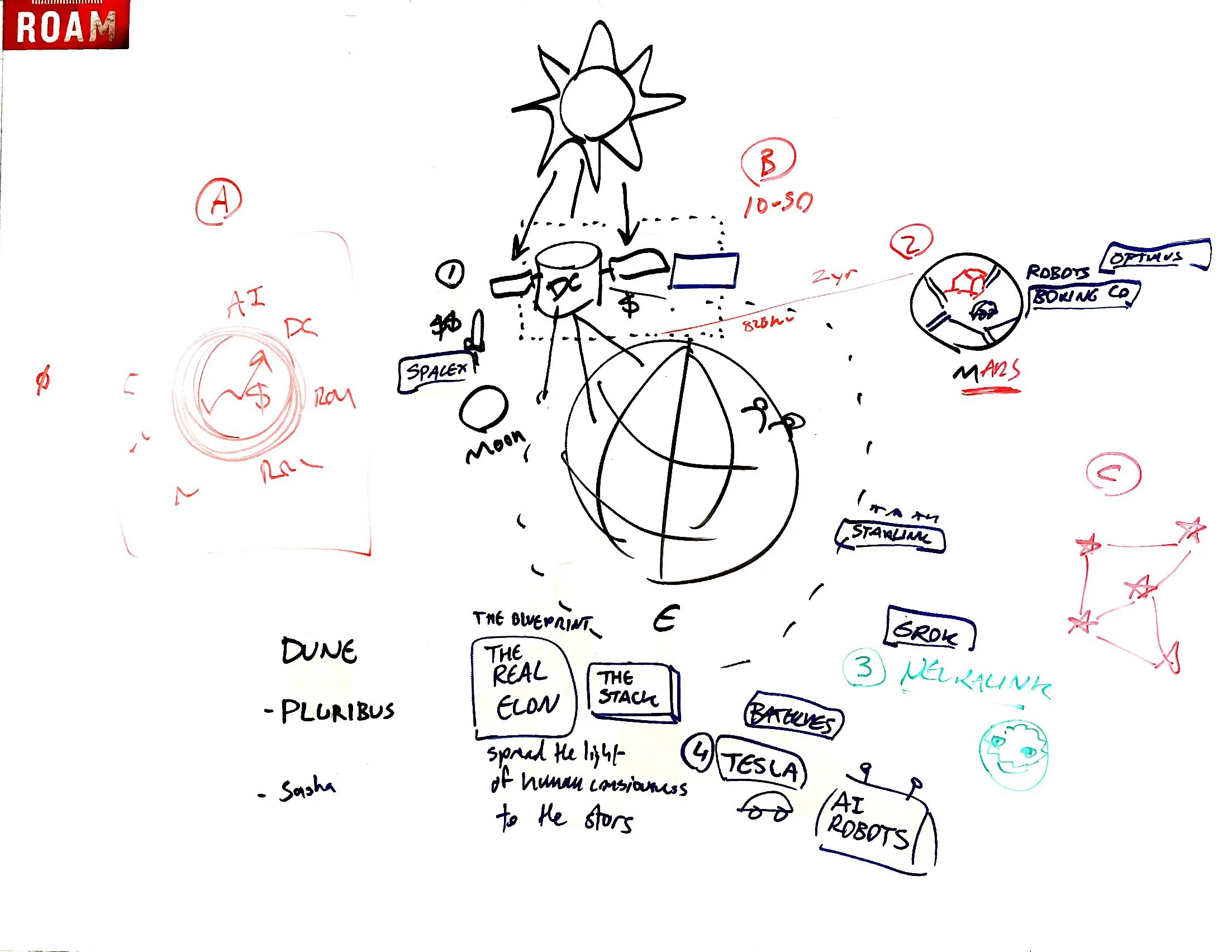
The earliest whiteboard sketch of this project, which Mark and I created earlier this year.
Notes & Sources
THE BLUEPRINT
Sources & Further Reading
Notes for the curious reader
This document collects the sources behind the claims in The Blueprint — the visual and written argument I published about how Elon Musk's eight companies, taken together, may compose a 100-year architecture for transmitting human consciousness to the stars.
The Blueprint is an interpretation, not a leaked plan. Musk has never publicly stated that consciousness-transmission is the goal connecting his companies. What he has done is state each component piece out loud — preserving the "light of consciousness," uploading minds into robot bodies, building orbital data centers, putting AI satellite factories on the Moon. The architecture connecting these pieces is what I drew. The pieces themselves are documented below.
Where claims rest on direct primary sources — Musk's own statements, SpaceX FCC filings, peer-reviewed papers — I link to them. Where claims rest on general physics, astronomy, or engineering knowledge that can be verified through any reasonable reference, I say so explicitly rather than invent citations.
If you find an error, please let me know at dan@danroam.com. I want this document to be as accurate as the argument it supports.
1. Musk's Own Statements
The Blueprint argues that Musk has said the parts of the architecture out loud — just not the connections between them. These are the primary statements I rely on.
The "light of consciousness" framing
This phrase is Musk's own, used consistently over more than a decade.
"My plan is to use the money to get humanity to Mars and preserve the light of consciousness." The defining statement of his stated purpose. Reported widely; one accessible secondary source is CBS News, October 2021.
Musk on X (then Twitter), March 21, 2021.
"I am accumulating resources to help make life multiplanetary & extend the light of consciousness to the stars." The earlier articulation of the same goal — and the one that names the stars directly.
Ross Andersen, "Exodus," Aeon, September 2014.
Long-form interview where Musk articulates the candle-in-the-darkness metaphor and frames human consciousness as fragile and worth preserving. The earliest detailed source for his philosophical framing.
Uploading consciousness into robot bodies
Musk has stated publicly that consciousness uploading via Neuralink, with re-embodiment in a robot body, is achievable within roughly 20 years.
Tesla 2025 Annual Shareholder Meeting, November 6, 2025.
Asked whether Optimus could one day house human consciousness, Musk responded: “It's not immediate, but if you say, down the road, would you be able to, say, with a Neuralink, have a snapshot of what is an approximate snapshot of somebody's mind and then upload that approximate snapshot to an Optimus body? I think that at some point, that technology becomes possible, and it's probably less than 20 years.” Widely reported; see Yahoo/AOL, Benzinga, and other coverage of the November 2025 meeting.[C1]
Lex Fridman Podcast #438 (Musk interview), 2024.
Extended conversation including discussion of Neuralink's trajectory, hundreds of millions of potential users, and consciousness preservation as a long-term goal.
The lunar AI satellite factory
This is the most direct evidence for The Blueprint's thesis that the Moon program is a manufacturing operation, not a settlement program.
xAI all-hands meeting, February 11, 2026 (publicly posted video).
Musk: "In order to go beyond a mere terawatt per year, you have to go to the moon. By having factories on the moon, building AI satellites, and having a mass driver — which is the kind of thing you really only read about in science fiction — we're going to do it... I really want to see a mass driver on the moon that is shooting AI satellites into deep space. Just going like 'shoom, shoom,' just one after the other." The Gizmodo article includes the extended transcript.
TechCrunch coverage, February 12, 2026.
Analysis of Musk's lunar-factory pitch as a reframing of SpaceX's vision following the xAI merger. Useful context for understanding the strategic and rhetorical shift.
Historical context — Gerard O'Neill proposed lunar mass drivers in 1974, Robert Peterkin filed a 2023 report on lunar electromagnetic launch for the Air Force Office of Scientific Research. The concept long predates Musk.
2. SpaceX Technical Filings & Corporate Documents
The SpaceX Orbital Data Center System (Phase 2-3 of The Blueprint)
On January 30, 2026, SpaceX filed with the FCC for authorization to deploy up to one million satellites operating as orbital data centers.
FCC Public Notice DA-26-113, February 4, 2026.
The official FCC document accepting SpaceX's application. Technical specifications: 500–2,000 km altitudes, 30-degree and sun-synchronous inclinations, narrow orbital shells up to 50 km, high-bandwidth optical inter-satellite links connecting to Starlink. This is the primary source for Phase 2-3 architectural claims.
SpaceNews coverage, January 31, 2026.
Detailed reporting on the FCC filing. Includes SpaceX's own framing: "a first step toward becoming a Kardashev Type II civilization — one that can harness the sun's full power." Cites SpaceX's claim that "by directly harnessing near-constant solar power with little operating or maintenance cost, these satellites will achieve transformative cost and energy efficiency."
Data Center Dynamics analysis, March 31, 2026.
Industry analysis of how the orbital data center plan fits within the broader space compute industry. Notes parallel filings by Blue Origin, Google, Starcloud.
TechBlog ComSoc, IEEE, February 2026.
Technical analysis from the IEEE Communications Society. Useful for understanding the radiative cooling and energy-density rationale for orbital compute.
Starship and the SpaceX-xAI merger
SpaceX-xAI merger, February 2, 2026.
Confirms the all-stock merger valuing the combined entity at approximately $1.25 trillion. The merger is explicitly motivated by orbital data centers — Musk: "Space-based AI is obviously the only way to scale."
SpaceX S-1 filing analysis, The Next Web, May 2026.
Notable for the tension between Musk's public confidence and SpaceX's own pre-IPO disclosures. The S-1 warns that orbital data center plans "involve significant technical complexity and unproven technologies, and may not achieve commercial viability" — useful for understanding the gap between rhetoric and engineering reality.
3. Parallel and Competing Programs
The Blueprint argues that orbital compute is industry consensus, not Musk eccentricity. These filings and reports demonstrate parallel efforts by major competitors.
Blue Origin Project Sunrise (March 2026 FCC filing).
Blue Origin filed with the FCC for 51,600 satellites operating between 500–1,800 km in sun-synchronous orbits — the same architectural pattern as SpaceX's filing. Strongest single piece of evidence that the orbital compute layer is industry consensus.
Google's announced partnership with Planet Labs to launch test satellites carrying TPUs into dawn-dusk sun-synchronous orbit. Plans to scale to terawatt-class compute clusters. Confirms a multi-company convergence on the same architectural pattern.
Starcloud (88,000-satellite proposal).
Independent orbital compute startup with similar architectural goals at smaller scale. Useful for confirming that orbital compute is being pursued by entrepreneurs beyond the major space companies.
NVIDIA's announced chip system designed specifically for orbital data centers. Confirms that semiconductor suppliers are tooling for the orbital compute market, not just speculating about it.
4. Mars Mission Engineering
The Blueprint's Phase 4 (Mars) makes specific claims about transit times, surface stays, and total mission duration. These are the engineering sources.
SpaceX Starship Mars mission profile.
SpaceX's own published mission planning, including 6-7 month one-way transit estimates assuming LEO orbital refueling. The current planning baseline.
Peer-reviewed feasibility paper demonstrating 90–104-day Starship transits with full propellant load, and showing that these faster trajectories stay within NASA career radiation limits while standard 180-day trajectories do not. The published-science version of the optimistic case.
NASA Mars Reference Architecture (SAC21).
NASA's current 850-day reference mission profile: 4 crew, 30 sols on surface, conjunction-class trajectory. The institutional baseline against which any commercial proposal is compared.
Peer-reviewed challenge to the Starship Mars architecture, noting that the proposed 200-ton landed mass is 200× the largest payload ever landed on Mars, and arguing for a 20-year development sequence before crewed feasibility. Important corrective to optimistic timelines.
SpaceX's Mars-plan delay, reported by Reuters, February 2026.
Reuters, citing a Wall Street Journal report, that SpaceX is delaying its Mars ambitions to focus on lunar missions. The clearest indicator that even SpaceX's own near-term planning has shifted toward the Moon as the primary operational target.
5. Lagrange Point Geometry & Physics
Phase 3 of The Blueprint (HALO) depends on the geometry and stability properties of the Earth-Moon Lagrange points. These claims rest on well-established physics rather than recent reporting; standard references suffice.
NASA Solar System Exploration: "What is a Lagrange Point?".
Plain-language introduction to all five Lagrange points, their stability properties (L1, L2, L3 unstable; L4, L5 stable), and current spacecraft using them (notably JWST at Sun-Earth L2).
Gerard K. O'Neill, "The High Frontier: Human Colonies in Space" (1976).
The foundational work proposing L4 and L5 as sites for permanent space settlements. O'Neill's vision is the direct intellectual ancestor of the HALO phase concept — though he imagined human habitats rather than compute platforms.
Earth-Moon Lagrange distances (NASA reference).
Standard reference values: L1 ~326,000 km from Earth, L2 ~449,000 km, L4/L5 at lunar distance ~384,000 km. The numbers used in The Blueprint.
6. Human Spaceflight Duration Records
The Blueprint's argument that "humans cannot be moved at useful interplanetary speeds" rests partly on the fact that long-duration spaceflight remains an experimental rather than operational capability — 31 years after the longest continuous mission was set.
Valery Polyakov, 437-day record (Mir, 1994-95).
The all-time record for longest continuous spaceflight, held by Russian cosmonaut Valery Polyakov, set 1994-1995 aboard Mir. 437 days, 17 hours, 38 minutes. Walked unaided from his capsule on landing to demonstrate Mars-class duration feasibility. NASA astronaut Norman Thagard described him as looking like he "could wrestle a bear."
Frank Rubio, U.S. record at 371 days (ISS, 2023).
The American record, set during an unplanned extension after his Soyuz return vehicle was damaged. Notable that the U.S. record is still substantially below Polyakov's 1995 mark — and that no agency has attempted to break it.
Oleg Kononenko, cumulative career record.
1,111 days cumulative across five missions. Useful for distinguishing single-mission duration from career-total exposure.
7. Cultural Reference Points
The Blueprint occasionally uses cultural references — most notably James Cameron's Avatar — as rhetorical anchors. These sources support those references.
Avatar: Interstellar Vehicle technical specifications.
The fictional Venture Star: 0.7c cruise velocity, hybrid photon-sail and matter-antimatter propulsion, 6.75-year one-way transit to Alpha Centauri (4.37 ly). Notable for being genuinely hard sci-fi — the design draws on real propulsion physics, including the matter-antimatter principles being explored in actual research at CERN and Fermilab.
Real-world program developing the light-sail propulsion concept on which Cameron's fictional ISV Venture Star was based. Provides the actual engineering reference point for Phase 5 (light-sail probes to nearby stars).
8. General Physics & Astronomy Background
Some claims in The Blueprint rely on standard astronomical or physics facts that don't require specific citation. I include them here for completeness.
• Speed of light: 299,792,458 m/sec, or approximately 186,282 mi/sec. Constants reference: NIST.
• Earth-Moon mean distance: 384,400 km (238,855 mi). NASA Moon fact sheet.
• Earth-Mars distance: varies from ~55 million km at opposition to ~400 million km at conjunction; average ~225 million km (~140 million mi). NASA Mars fact sheet.
• Proxima Centauri distance: 4.2465 light-years (40.17 trillion km). Gaia DR3 catalog.
• Lunar escape velocity: 2.38 km/sec. Standard physics reference.
• Mars launch windows: every ~26 months (780-day synodic period). Orbital mechanics standard.
• Galactic Cosmic Ray flux at interplanetary distances and NASA career radiation limits: NASA Space Radiation Element documentation.
On Methodology
I am not a journalist. I am a visual thinker who saw a pattern in the public record and tried to draw it. The Blueprint is my interpretation of how Musk's portfolio fits together — an argument by composition, not an exposé.
Two principles guided the research:
First, I prioritized primary sources — Musk's own statements, FCC filings, peer-reviewed papers, NASA reference documents — over secondary reporting. Where I cite secondary sources, it's because they accessibly summarize primary material that would otherwise require wading through legal or technical documents.
Second, I distinguished what Musk has said from what I have inferred. The phrase "light of consciousness" is his. The architecture connecting his companies into a consciousness-transmission system is my interpretation. Both deserve to be in the open.
If The Blueprint's thesis is right, the architecture is being built whether Musk has stated the connection or not. If it's wrong, the architecture's components still exist — they just compose into something different. Either way, the pieces themselves are documented above.
Corrections & Further Reading
If you find an error in any specific citation, find a stronger source, or want to extend the argument in a direction I haven't, please email dan@danroam.com. I am especially interested in:
• Primary sources I missed
• Counter-arguments to the thesis from people working inside the relevant industries
• Engineering challenges to specific phase claims (especially Phase 5 light-sail mechanics)
• Better citations for the Tesla shareholder meeting consciousness-upload quote
The Blueprint will continue to evolve. This sources document will evolve with it.
— Dan Roam
dan@danroam.com
Version 1.0 — May 2026
[C1]Verified against Yahoo/AOL coverage of the Tesla 2025 Annual Shareholder Meeting (Nov 6, 2025). This quote rests on secondary reporting, not a primary Tesla transcript. If a primary recording becomes available, cite that instead.