
The Blueprint:
How SpaceX Plans to Colonize the Cosmos in the Next One Hundred Years
Next month’s SpaceX IPO is being called the biggest in history.
I think the analysts are missing the actual story.
Elon Musk isn't building a rocket company. He's building something much more interesting: a way to send human consciousness to the stars.
Think about it: SpaceX is just one of eight companies Musk runs. Why does a rocket company need a brain-implant company? Why does a car maker need an AI lab?
I went looking for answers. And I think I found it.
It's not what Musk says publicly. It's in what his companies, taken together, are able to do.
Here's the punchline, then I'll show you the work:
Humans cannot be moved at useful interplanetary speeds. Human consciousness can.
Every Musk company — SpaceX, Tesla, Neuralink, xAI, The Boring Company, Starlink, Optimus — is a necessary component of a single 100-year system whose purpose is to encode, transmit, and re-embody human minds at the speed of light.
Earth builds the prototype.
The Moon builds the factory.
Orbital data centers spread the word.
Mars proves the concept.
The stars are the destination.
I call it The Blueprint.
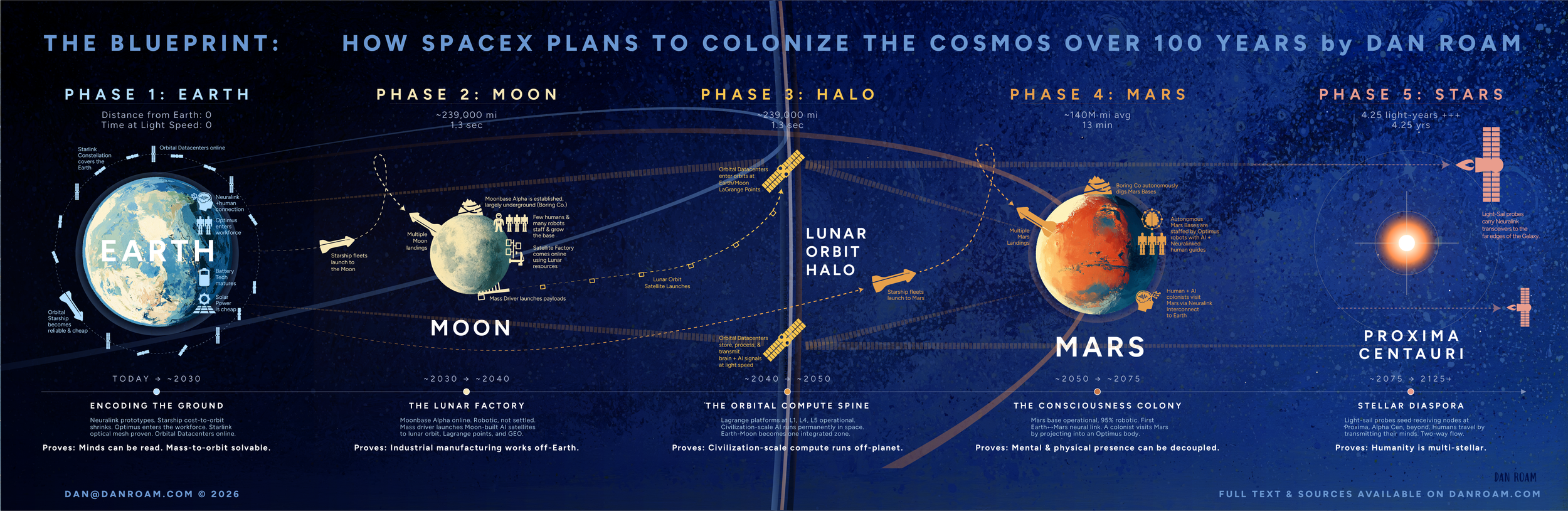
The diagram in the carousel below walks through all five phases. The short version:
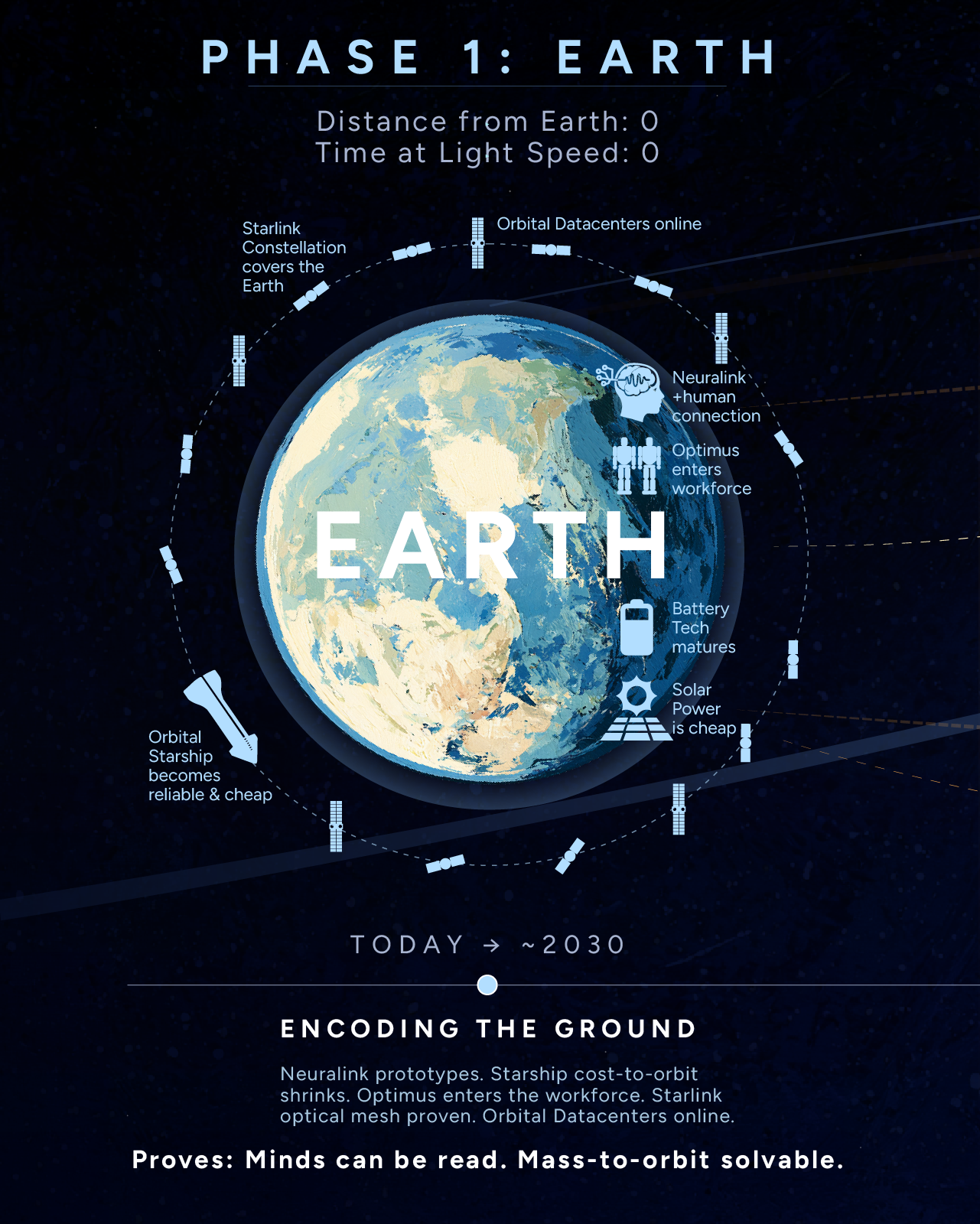
Phase 1 — EARTH (today → 2030). Neuralink learns to read human thought. Optimus learns skilled physical work. Starship makes mass-to-orbit cheap. xAI's compute substrate gets ready. Every component of the consciousness-transmission stack gets prototyped on Earth.
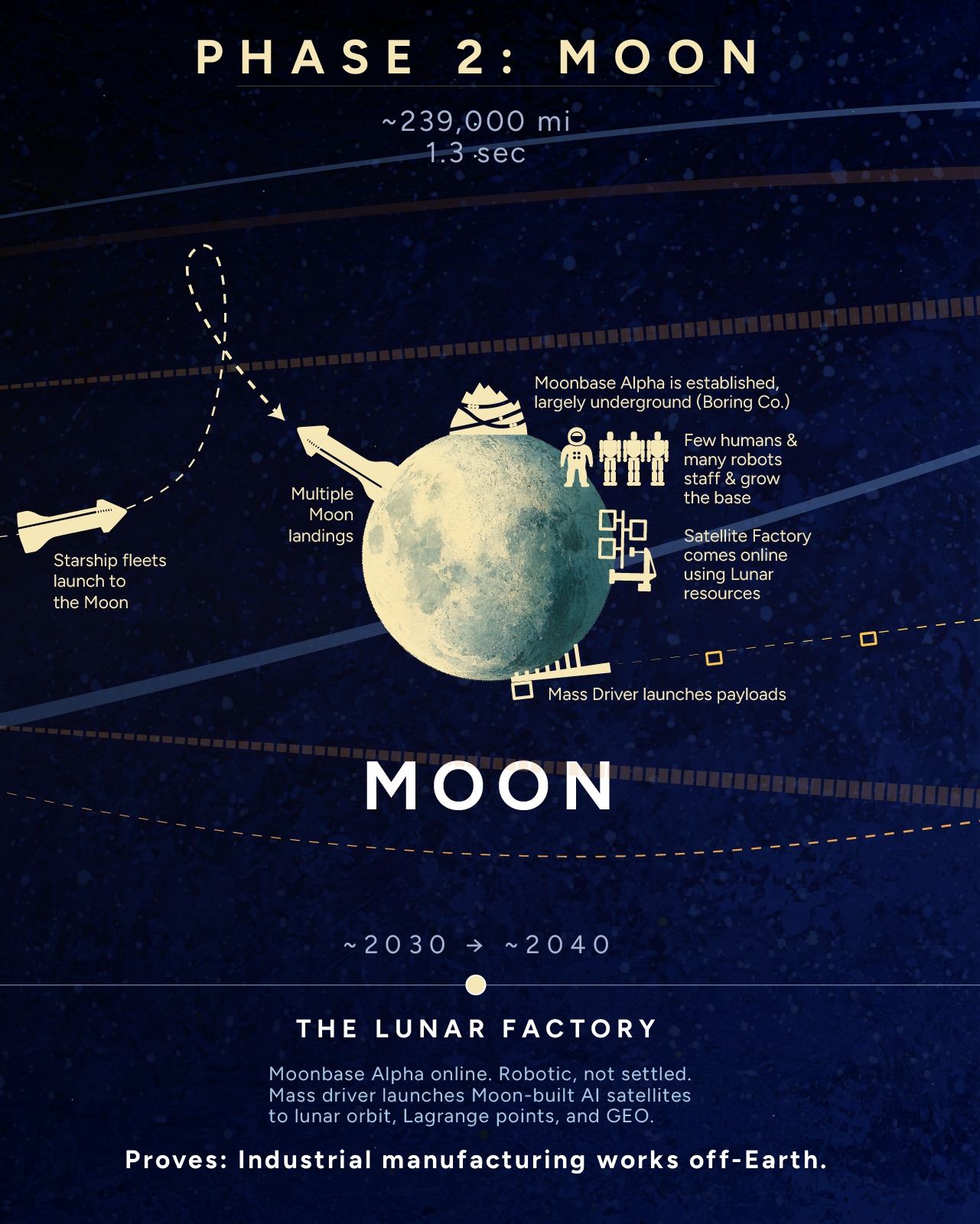
Phase 2 — MOON (2030 → 2050). Robotic industrial complex on the lunar surface, built by Optimus, powered by Tesla, tunneled by Boring Co. Almost no humans. A mass driver — a long electromagnetic launch track — fires Moon-built AI satellites into cislunar space at 2.38 km/sec, no chemical propellant required. The Moon becomes the factory.
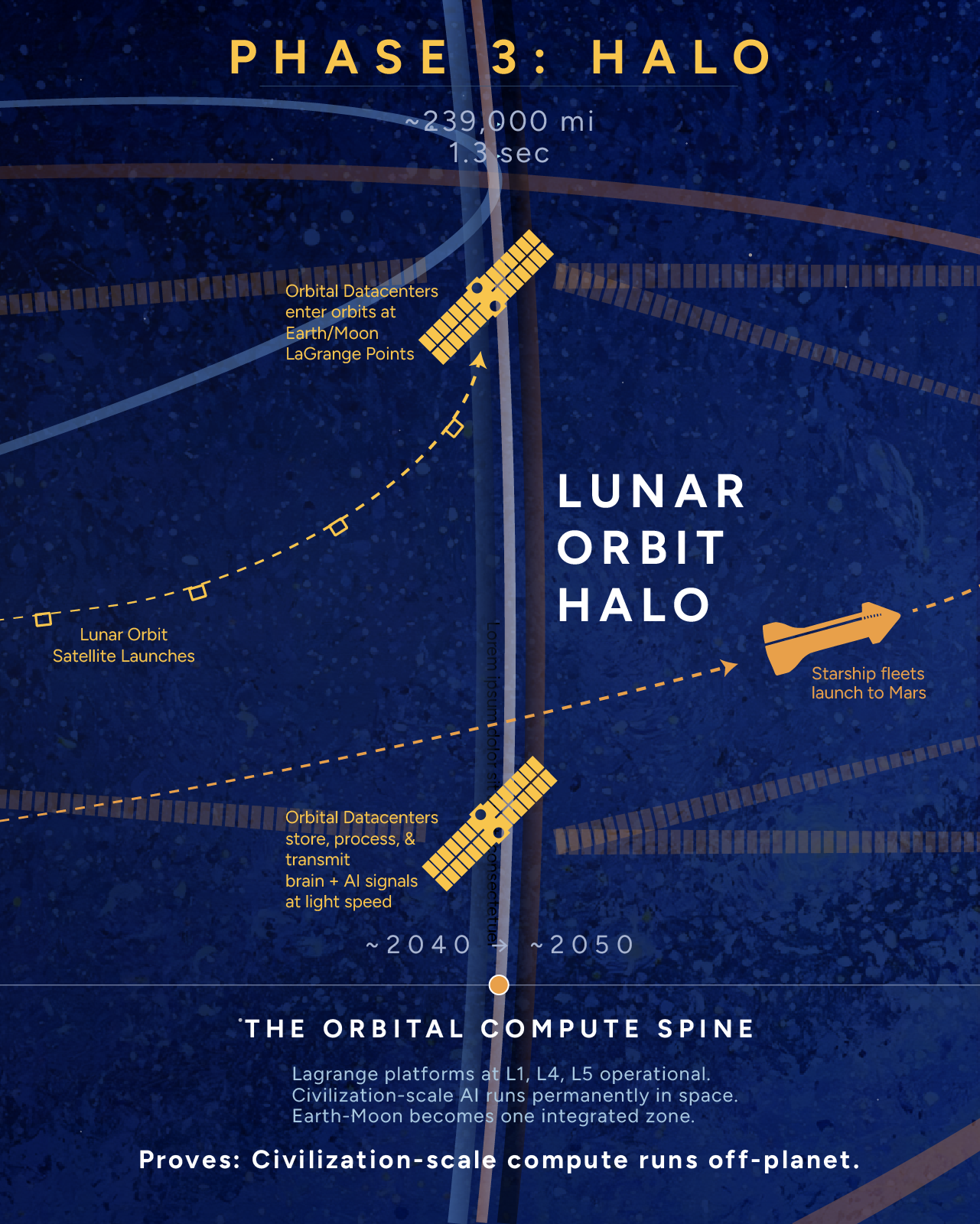
Phase 3 — HALO (2045 → 2065). The Lagrange points between Earth and Moon fill up with permanent solar-powered compute platforms. Continuously sunlit. Gravitationally stable. The substrate on which civilization-scale AI now runs. The Earth-Moon system becomes one integrated economic and computational zone.
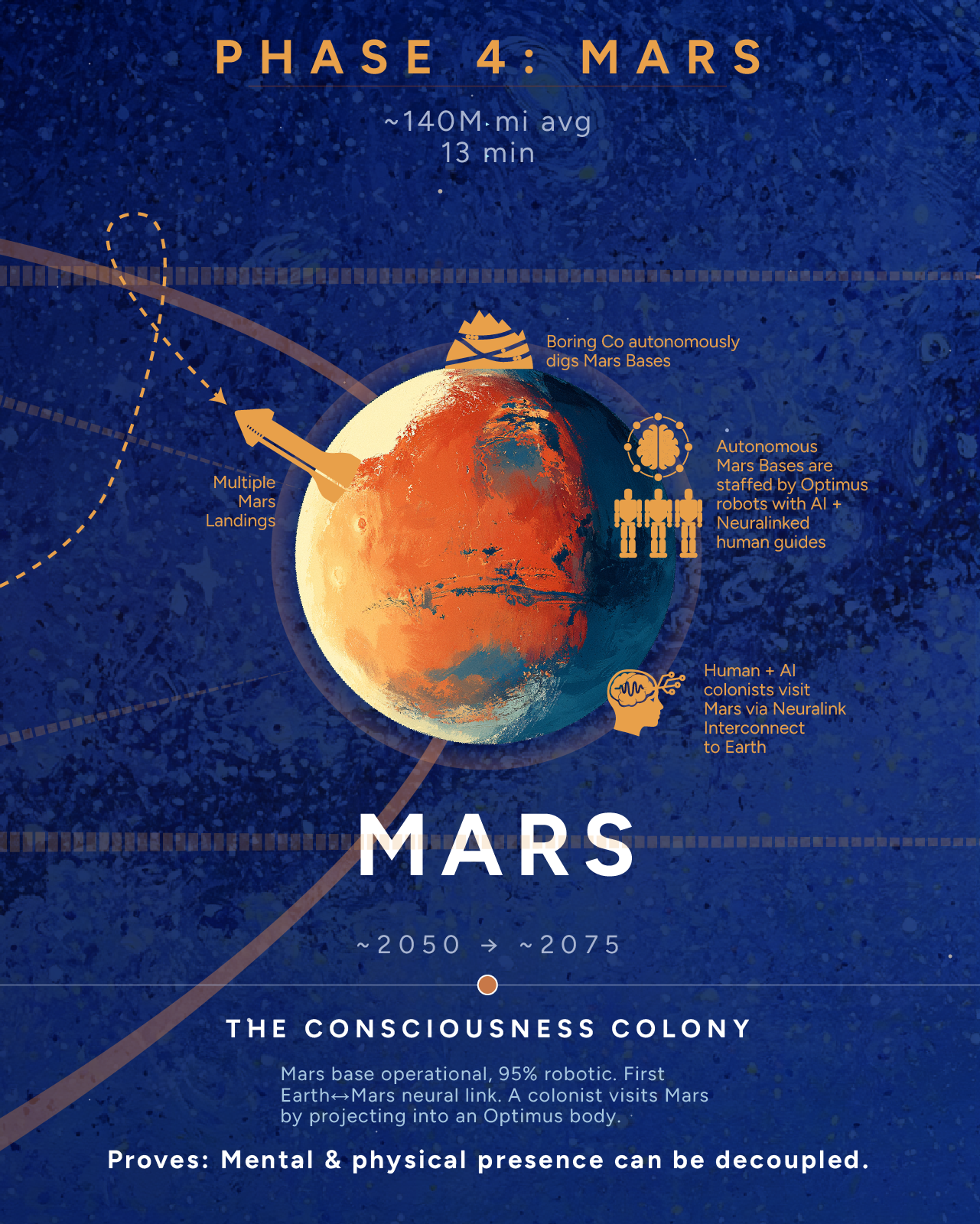
Phase 4 — MARS (2065 → 2090). A robotic Mars base goes operational before any human sets foot there. When humans do visit, they come in small numbers. The real population of Mars is consciousness, projected into Optimus bodies via Neuralink. A colonist on Earth puts on a headset and spends a shift on Mars. Light-lag is 8–48 minutes one way. Presence and biological location are now decoupled.
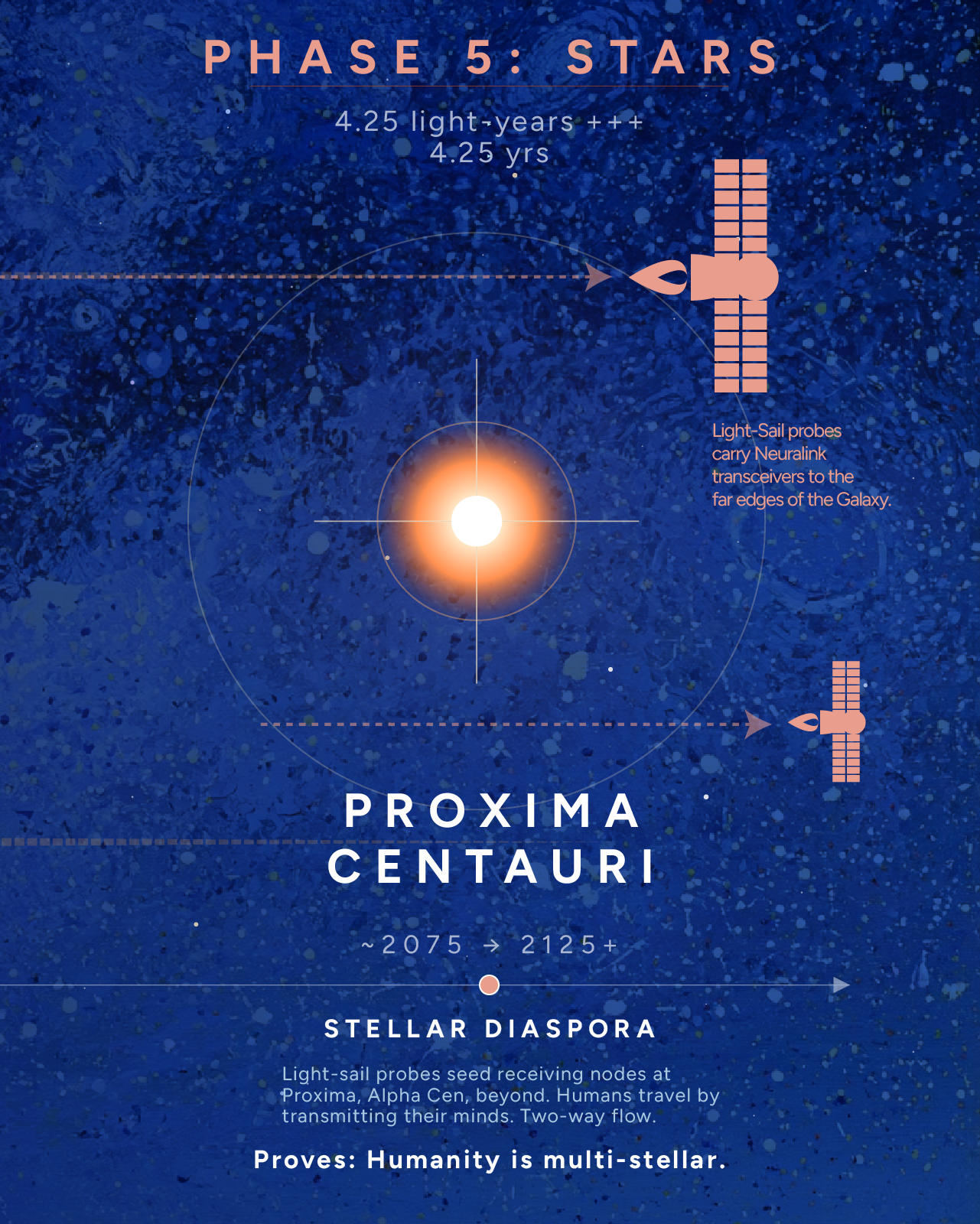
Phase 5 — STARS (2090 → 2125+). Light-sail probes seed receiving nodes at Proxima Centauri, Alpha Centauri, Wolf 359. Once a node is live, any consciousness can be transmitted there at light speed and instantiated in a waiting body. A "trip to Proxima" takes 4.2 years for the signal; instantaneous for the traveler. The architecture goes recursive. Each new stellar node seeds further stars.
This is what the SpaceX IPO is really funding.
Two things worth knowing before you dismiss this:
First, Musk has said the parts out loud. "My plan is to use the money to get humanity to Mars and preserve the light of consciousness" (X, Oct 2021). "You can take a rough snapshot of someone's mind with Neuralink and upload that rough copy into a robot body. I think at some point it will be possible, probably in less than 20 years" (Tesla shareholder meeting, 2024). The goal — light of consciousness — is his phrase. The mechanism — upload into a robot body — is his prediction. The architecture connecting them is what I've drawn.
Second, the financial press isn't asking these questions because the financial press isn't paid to. The "smart money" is pricing year-over-year cash flow. The smart bet — the one Musk's investors are actually making — is that the combined portfolio is worth more than the sum of its parts because the parts only make sense together.
You don't have to like Elon Musk to find this interesting. You just have to be willing to see the pattern.
Curious whether you see it.
Do you think this read of his portfolio is right, partly right, or completely wrong? What does the alternative interpretation look like? Reply in the comments — I'm genuinely interested in pushback.
— Dan Roam
Full research, sources, and the high-resolution diagram are at danroam.com